Anyone who reads research the way I used to has faced this problem at one point in their research career. You hit a concept you don't understand, you upload the paper into an LLM, and you start asking questions. It works for a while. Then somewhere around the twenty-fifth prompt, the thread dies. It contradicts itself. Hand it more than ten papers at once and it stops cross-referencing them entirely. Ask one specific topic and you get three paragraphs of generic examples instead of the actual finding.
I spent enough late nights fighting the cause to realize the problem isn't intelligence. It's memory. The context you build up over a research session lives in a window that keeps sliding, and the moment something falls off the edge, it's gone. So I built Pantomath AI, a personal research companion where the memory doesn't live in the model's window. It lives in a graph, in HydraDB.
Here's how it works
The whole retrieval path is one call. One query() with query_by="hybrid" and graph_context=True, and HydraDB fuses vector similarity and graph traversal into a single ranked result, pulling from the papers I ingested and every prior turn in the session, merged by relevance score. Gemini 2.0 Flash then phrases the answer, and only from those retrieved chunks, keeping the answers grounded and cited.
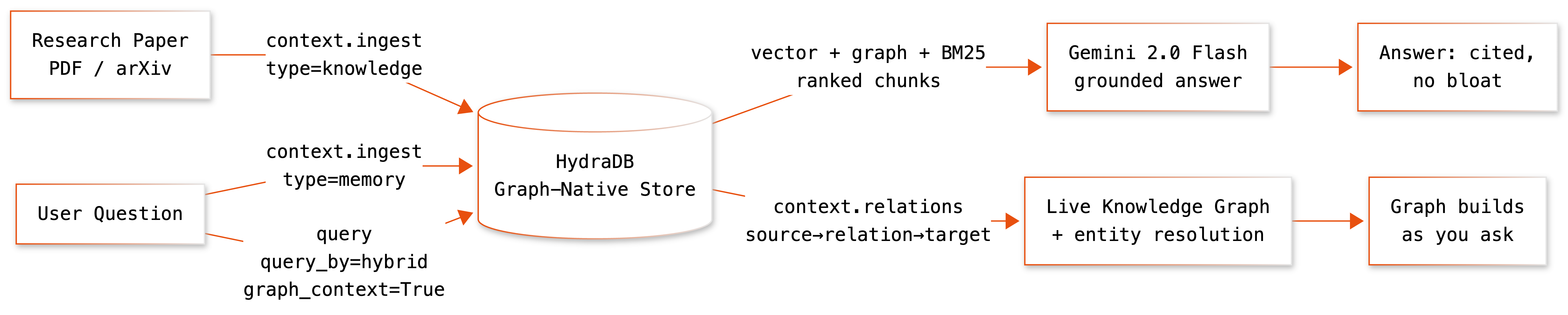
The memory itself is just two ingest calls. Papers go in as knowledge, while every question and answer turn goes in as memory, tagged with the session and turn number. Over twenty-five prompts deep, the context still remains there.
And the graph you'd expect to build yourself, HydraDB builds for you. context.relations() returns the entity graph as source→relation→target triplets, and Pantomath AI renders it live. It accumulates live as you ask questions, so a graph forms for the paper you're reading, showing how its concepts actually connect. The piece I didn't expect: when one paper says "feature superposition" and another says "feature multiplexing," HydraDB resolves them to the same concept on its own. The graph-native engine just works exceptionally well.
Why it convinced me
I've built on enough infrastructure to be wary of anything that promises to collapse three systems into one. But the honest test is whether it saves you the integration you'd otherwise do by hand, and here it did. The graph, the entity resolution, the hybrid recall across memory and knowledge, those are the exact things I would have had to spend a week stitching together. HydraDB treats them as primitives.
Pantomath is live at pantomathai.abhirupvg.com, and yes, it remembers what I told it thirty prompts ago, and it answers from the paper itself instead of giving unrelated hypothetical case scenarios for the paper. This is the whole reason I built it.